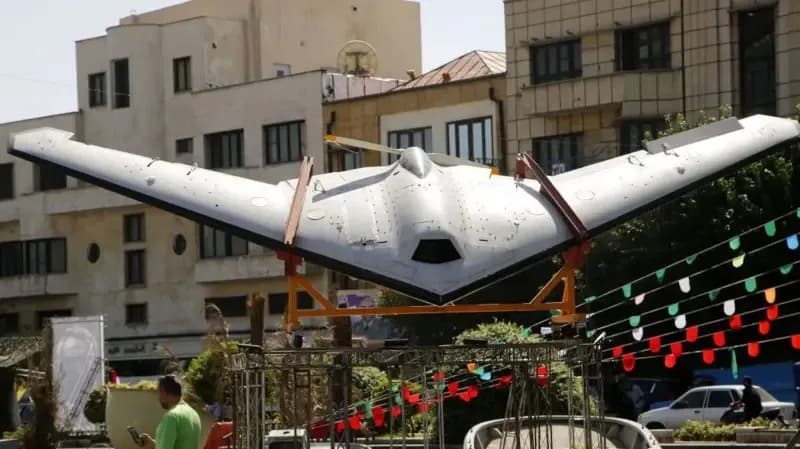

Experts say that, contrary to common belief, many of the parts in Iran's drones are neither highly advanced nor especially costly.
In September 2023, the US Treasury Department said a component recovered from the wreckage of a Shahed-136 drone had been traced to a procurement network that bought it for Iran's drone programme.
Russia had used the drone in the war in Ukraine. The part in question was a small servo motor, which controls the drone's movement.
According to the US Treasury, an Iranian company bought thousands of servo motors for the Islamic Revolutionary Guard Corps' Aerospace Force through companies in Hong Kong, Turkey and the United Arab Emirates.
In April and May 2026, the Treasury also announced new measures against people and companies it said were involved in supplying components and raw materials that Iran's military industry needs.
Even under extensive sanctions, Iran still depends on foreign-made components to build its drones. US sanctions documents name networks of companies and commercial middlemen that Washington says help supply them.
Using those documents, published research and expert opinion, this report looks at how such networks work and how sanctions affect the supply of parts for Iran's drone programme.
Damien Spleeters, a defence expert and founder of the consultancy Hæimdal, says assessments of how well sanctions work are often wrong.
Sources
- WebsiteBBC NEWS