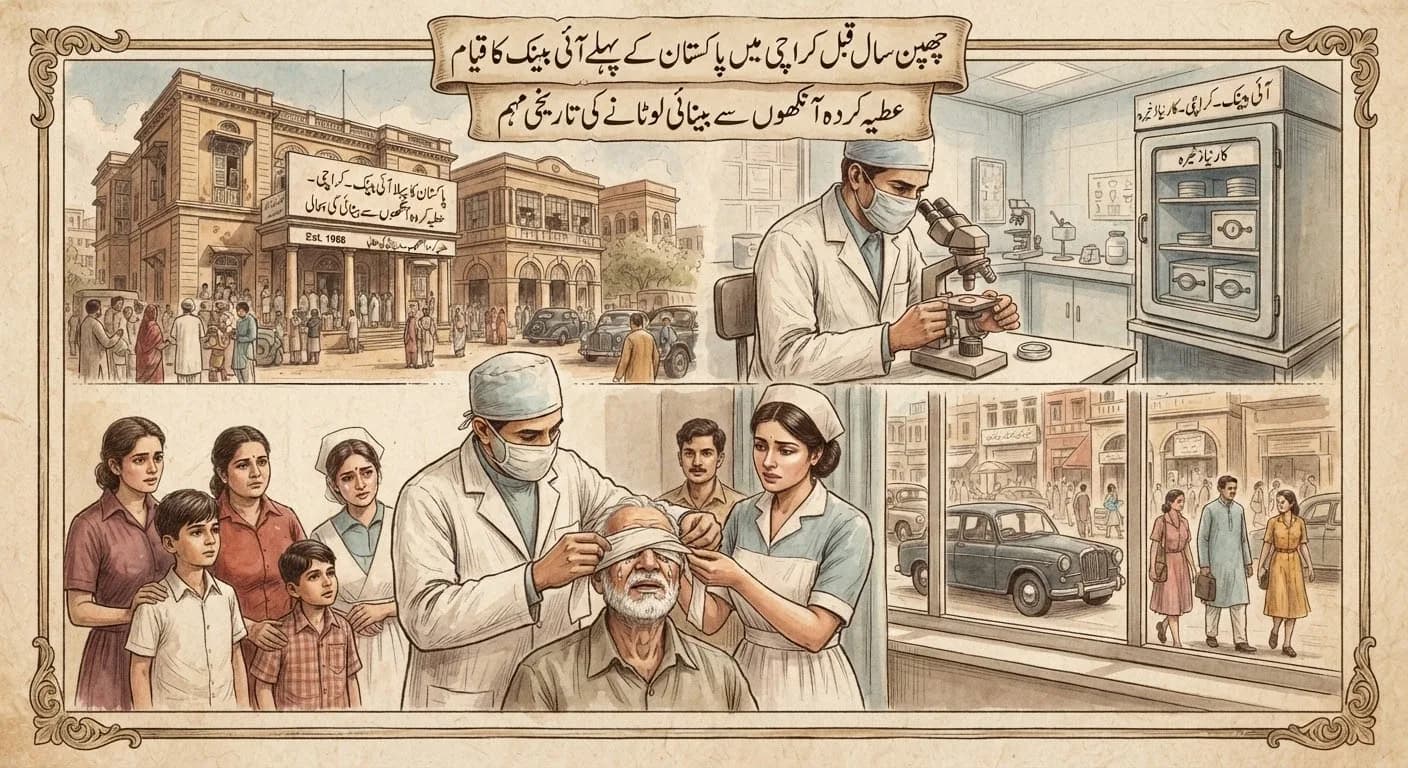
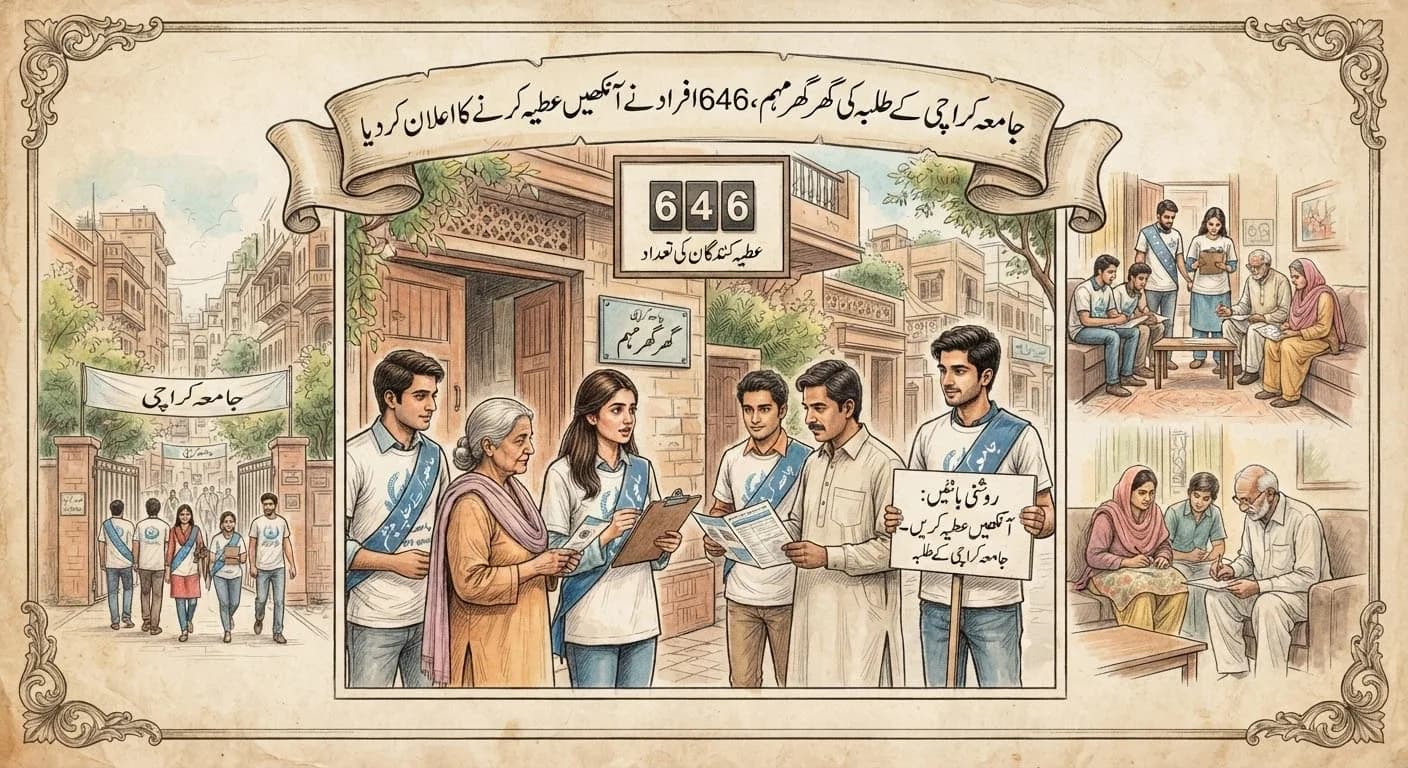
 AI-generated image
HealthFeatureThe Story of Turning Darkness into Light: A Remarkable Journey
Pakistan’s First Eye Bank Established in Karachi 56 Years Ago: A Historic Campaign to Restore Sight Through Eye Donations
Before the facility was established, some donated eyes imported from abroad were wasted due to the absence of proper preservation arrangements. Following the establishment of the country’s first eye bank, 646 people pledged to donate their eyes after death, including 100 inmates of Karachi Central Jail.

A historic milestone in Pakistan’s medical history was achieved 56 years ago when the country’s first eye bank was inaugurated in Karachi on May 12, 1971. The initiative not only introduced an important medical facility but also helped promote the culture of eye donation after death, offering hope of restored vision to people suffering from blindness.
The first eye bank was established at Karachi’s Spencer Eye Hospital and inaugurated by the then Governor of Sindh and Martial Law Administrator Zone D, General Rehman Gul.
The Lions Club played a key role in establishing the facility, while Karachi-based businessman Mian Muhammad Sadiq Munno contributed Rs50,000 towards the project, a substantial amount at the time.
The inauguration ceremony also marked the opening of the newly constructed Kulsoom Bai Valika Ward at Spencer Eye Hospital.
Addressing the ceremony, General Rehman Gul praised the Valika Trust for constructing the ward at a cost of Rs200,000. He also appreciated the Lions Club’s initiative to establish an eye bank and acknowledged Mian Muhammad Sadiq Munno’s generous financial contribution.
Dr M.H. Rizvi, the internationally recognised ophthalmologist heading Spencer Eye Hospital and the first eye bank, said the new ward had increased the hospital’s capacity by another 100 patients. He added that the facility would provide treatment to eye patients coming from different parts of the country and appealed to philanthropists to extend further financial support.
Najmuddin Valika of the Valika Trust assured continued assistance, while Noor Muhammad of the Lions Club described the establishment of the eye bank as an urgent necessity.
Why Pakistan Needed an Eye Bank
Before the establishment of the eye bank, Pakistan had no adequate facility to preserve donated eyes. Approximately 50 donated eyes were being imported every month from Sri Lanka and the United States for patients suffering from blindness.
However, due to the absence of proper preservation facilities, some of these donated eyes went to waste.
Recognising the seriousness of the problem, Dr M.H. Rizvi urged the Lions Club to establish an eye bank at Spencer Eye Hospital. His vision was not only to ensure the safe preservation of imported donations but also to encourage Pakistanis to pledge their eyes for donation after death.
University of Karachi Students Launch Door-to-Door Campaign: 646 People Pledge Eye Donations
Following the establishment of the eye bank, the Lions Club launched an unprecedented public awareness campaign with the assistance of students from the University of Karachi.
The student volunteers included Nasreen Hai, Nargis Nazhat, Kamal Ahmed and Abdul Aziz. They went door to door, educating people about the importance of donating their eyes after death and encouraging them to become part of this humanitarian cause.
The campaign produced an extraordinary response, with 646 people pledging to donate their eyes after death.
Among those who made the pledge were former Governor of Sindh Habib Ibrahim Rahmatullah, a surgeon at Jinnah Hospital identified as Qazi, Dr Aqila Kiyani, head of the Department of Social Welfare at the University of Karachi, and Ms Hafiza Brohi and Tahira Brohi, daughters of former Law Minister A.K. Brohi.
Begum Pirzada, President of the Zonta Club, was also among those who pledged their eyes.
Members of the Gul Rana Club, students from Khurshid Girls College, S.M. College and Jamia Millia College also joined the campaign.
In a remarkable development, 100 inmates of Karachi Central Jail also volunteered to donate their eyes after death.
Under the procedure outlined at the time, the eyes were to be retrieved within two hours of the donor’s death and preserved at the eye bank so that their corneas could be transplanted into patients in need.
Only Four Pakistanis Had Pledged Eye Donations Before May 1971
The significance of the campaign can be understood from the fact that between the establishment of Pakistan and May 1971, only four Pakistanis had pledged to donate their eyes.
Among them were two prisoners sentenced to death in murder cases: Habibullah, who made his pledge in 1966, and Muhammad Umar, who offered his eyes in 1956. Their donated eyes were subsequently used for patients in need.
The establishment of Pakistan’s first eye bank in Karachi on May 12, 1971, was therefore much more than the introduction of a medical facility. It marked the beginning of a remarkable humanitarian movement that encouraged hundreds of people to pledge that even after their death, they could help restore someone else’s sight.
It was a powerful example of how a person’s final act of generosity could bring light into another human being’s life
Join the discussion
No comments yet. Be the first to weigh in.
Read next
Related coverage
Pakistan
Tharparkar ambulance blaze kills eight, including a pregnant woman and four hospital staff
Health
PIMS Governance Reforms: Recommendation to Place Hospital Under Board of Governors
Latest
Pakistan
Commissioner Hyderabad Orders Cancellation of 1,338 Acres of Bahria Town Land in Jamshoro Worth Over Rs64 Billion.Crime
Karachi: Fitna al-Khawarij Terrorist Arrested in Manghopir, Rangers Spokesperson SaysPakistan
Bilawal Bhutto Will Be Responsible If Even a Single Drop of Blood Is Shed in Sindh: Mustafa KamalPakistan
Rangers’ High-Level Meeting Takes Key Decisions to Improve Law and Order in KarachiPakistan
Bilawal Bhutto Warns of Widespread Bloodshed if Sindh Is Divided by Force
More from Health