EXCLUSIVEPakistanFeatureIconic Arch
25 Years Ago, Karachi’s Iconic Paradise Point Rock Arch Collapsed into the Sea
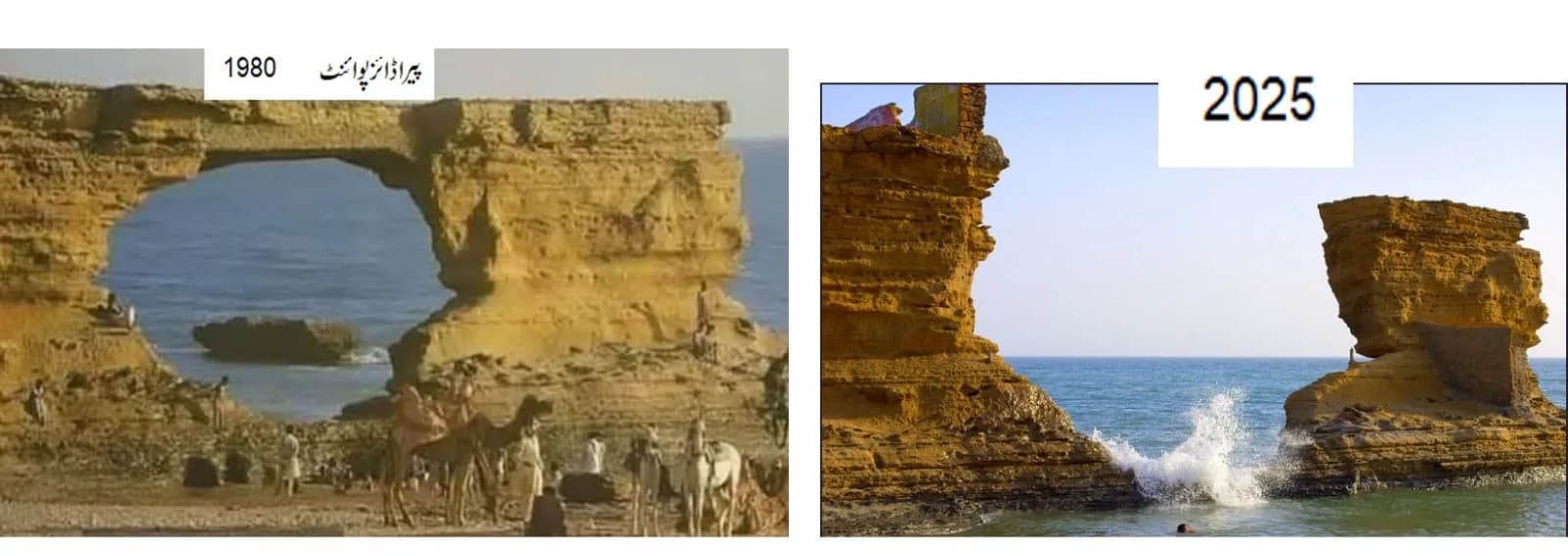
A natural wonder that remained a symbol of Karachi’s coastline for centuries disappeared forever on June 12, 2001, following a massive collapse.

Karachi, often described as the Bride of Cities, has an approximately 90-to-100-kilometre-long coastline, stretching from Mubarak Village in the west to Korangi Creek and Bin Qasim Port in the east. The coastline is home to several beautiful recreational destinations, including Mubarak Village, Cape Monze (Ras Muari), Churna Island, Sandspit, Paradise Point, Hawke’s Bay, Clifton and Sea View. Each location has its own distinct identity, but Paradise Point was particularly famous for a unique natural rock arch that had become one of Karachi’s most recognisable coastal landmarks.
It was Tuesday, June 12, 2001, at around 5:45 pm. Visitors who had come to escape the scorching heat and enjoy the seaside were preparing to leave after spending the day at the beach when a sudden, powerful explosion-like sound was heard amid the roar of the sea.
People turned towards the source of the noise in shock. What they witnessed left them heartbroken. The upper section of the natural rock formation at Paradise Point had collapsed.
The historic arch, which had remained a distinctive feature of Karachi’s coastline for centuries, was gone.
The natural rock arch was the principal attraction that gave Paradise Point its unique identity. The site was popular not only among ordinary visitors but also within Pakistan’s entertainment industry. Numerous films were shot here, making it one of Karachi’s most picturesque natural locations.
During winter, when the sea was relatively calm, visitors would stand beneath the natural arch, admire the breathtaking views and take photographs. During the monsoon season, however, the location became dangerous as powerful waves crashed against the rocks, creating a spectacular natural display that continued to attract visitors.
An ambitious development project left incomplete
At the time of the collapse, administrative responsibility for the coastal area rested with the Lyari Development Authority (LDA). Earlier, in 1986, when the area was under the Karachi Development Authority (KDA), development work had been initiated under a coastal development scheme.
According to maps prepared during that period, the famous rock arch was identified under Survey Number ST-17.
The development plan covered approximately 25 acres and included a camping ground, playground, children's park, shaded reinforced-concrete structures, a swimming pool, freshwater showers, parking facilities, a bus terminal, safety railings, paved steps leading towards the sea, fast-food restaurants, a first-aid post and a modern hotel.
Some initial work was undertaken during the tenure of Sindh Governor Jahandad Khan. However, like several other development initiatives, the project eventually became another unfinished undertaking.
Why did efforts to preserve the natural arch fail?
It is reported that the KDA had undertaken cementation work beneath the natural arch in an attempt to strengthen and protect the formation.
However, according to some experts, the additional weight of cement beneath the already weakened natural roof may have disturbed its structural balance and contributed to its eventual collapse.
This raises an important question: Could the natural landmark have survived for several more decades if appropriate engineering assessments, scientific conservation measures and timely protective interventions had been undertaken?
Twenty-five years have passed since the collapse of Paradise Point's iconic rock arch, but its old photographs and videos continue to evoke memories of Karachi's coastal heritage.
It was more than just a natural rock formation. It represented an important part of the city's coastal history, collective memories and recreational culture.
Had its significance been recognised in time, and had proper scientific conservation measures been taken, this natural treasure might still have been standing today.
Even now, looking at its photographs brings a sense of loss. Karachi has lost a unique chapter of its natural heritage, one that no modern recreational development can ever truly replace.
Join the discussion
No comments yet. Be the first to weigh in.
Read next

Related coverage

Pakistan
Has Khalid Maqbool Siddiqui Lost the Chairmanship of MQM-Pakistan?
Pakistan
Senior Journalist Ammar Masood’s Analysis of Federal Health Minister Syed Mustafa Kamal’s Press Conference.
Pakistan
Border Health Services Responsible for Irregularities in Vaccine Procurement, Inquiry Report Reveals
Pakistan
Water Enters Under-Construction Powerhouse at Tarbela 5th Extension Project After Tunnel Collapse
Latest
Lifestyle & Society
The Vespa Scooter: A Ride, a Journey Through an EraEXCLUSIVEEducation
Retired Faculty of Federal Urdu University Forced to Approach Courts for Pension Dues; Why Is Federal Education Minister Khalid Maqbool Siddiqui Silent?Pakistan
Has Khalid Maqbool Siddiqui Lost the Chairmanship of MQM-Pakistan?Business
Karachi Police Assures Traders of Full Cooperation in Ensuring Their Security and Resolving Issues: Additional IGPakistan
Senior Journalist Ammar Masood’s Analysis of Federal Health Minister Syed Mustafa Kamal’s Press Conference.
More from Pakistan