Opinion & AnalysisOpinion
Karachi’s Changing Face: Crisis, Indifference and Inequality
A conversation about Karachi’s changing conditions opens a wider examination of civic failure, addiction, crime, unequal enforcement and a growing indifference to the suffering around us.
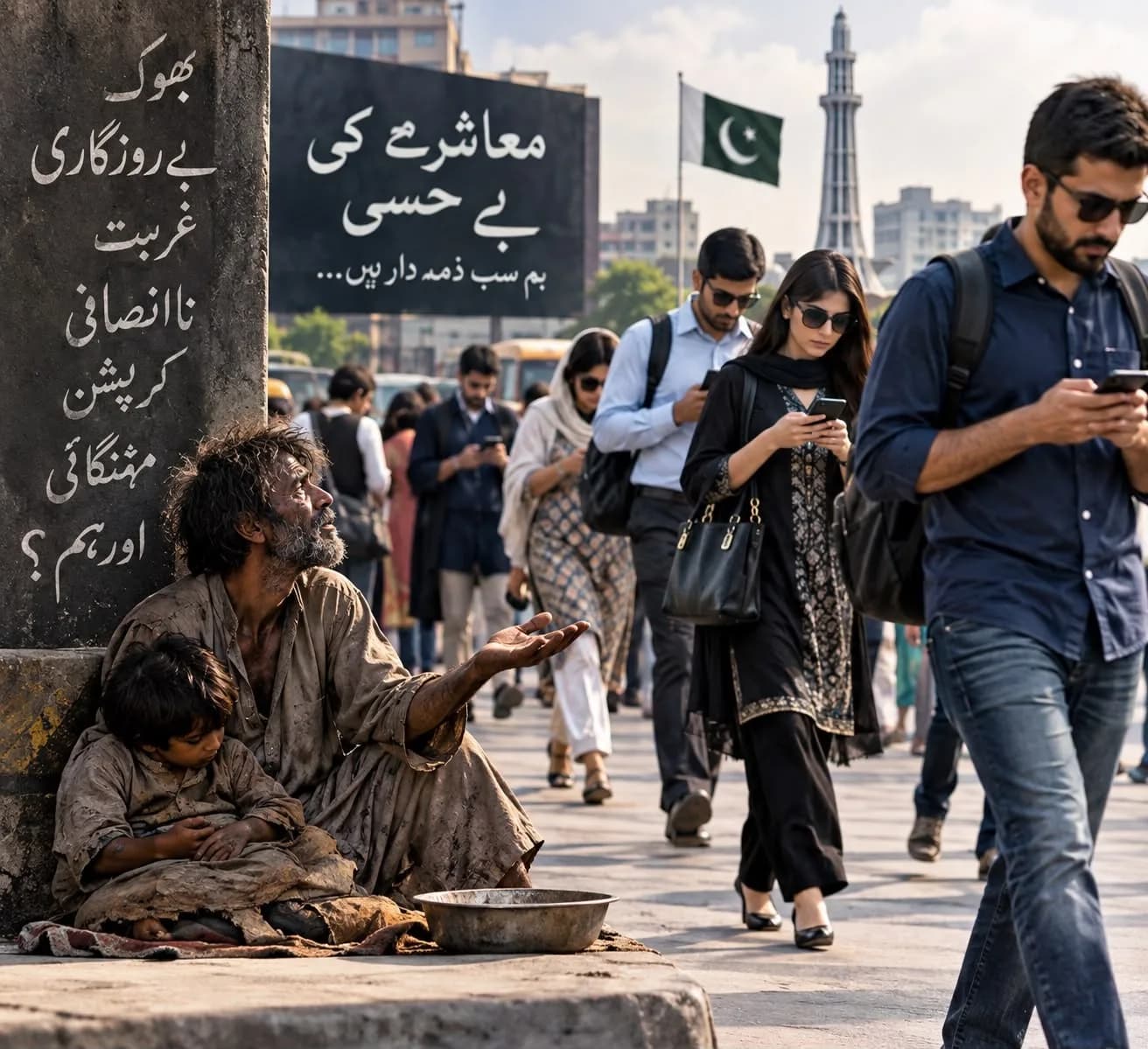
Over the past few days, a conversation took place with friends Shezan Khan, Saleemullah Siddiqui and Imran Ahmed, beginning with a discussion about Karachi’s changing conditions, the behaviour of government institutions toward citizens, and the growing indifference in society. What started as a conversation about Karachi quickly expanded into a discussion of the country’s overall situation, public difficulties and the state of the present system. Different aspects came under discussion, and each person expressed his views on the current situation in light of his own observations and experiences.
Shezan Khan said that today there is hardly any section of society that is not facing some kind of difficulty, deprivation or anxiety. Inflation has broken the back of the ordinary person, unemployment has tied the hands of young people, civic problems have made urban life painful, and the indifference of government institutions has created a feeling among people that there is no one to listen to their grievances.
Taking the discussion further, Saleemullah Siddiqui and Imran Ahmed also drew attention to the fact that civic problems are no longer merely administrative in nature. Their effects are now clearly visible in social attitudes, mental well-being and mutual tolerance. Today, everyone is blaming someone else. Citizens blame the government, the government blames the federation, the federation blames the province, the province blames institutions, and institutions blame a lack of resources. But where does the ordinary citizen stand amid all this blame? He is trying to live his everyday life while dealing with problems of electricity, water, transport, inflation, education, healthcare, employment and law and order.
When we look at a city like Karachi, this crisis becomes even more visible. On one side are high-rise buildings, large shopping malls, people shopping in them, expensive cars and wide roads. On the other are people sleeping on footpaths, children searching for food in piles of garbage, people struggling with drug addiction, and settlements deprived of basic facilities. The two contrasting faces of life stand side by side in the same city.
One aspect of the discussion about people struggling with drug addiction was particularly worth considering. It was felt that some people living on the margins of society now appear to be beyond even the fear of the law. People can be seen openly using drugs in the city’s underpasses, beneath bridges, along roadsides and on footpaths. In some places, incidents involving people picking objects from garbage and committing theft have also become a persistent problem for citizens.
Theft, damaging public or private property, or creating a danger for citizens cannot be accepted under any circumstances. But another question must also be asked: how did a person who has almost lost his life, health and social relationships reach this point? If drugs are easily available in a city, employment opportunities are limited, treatment and rehabilitation centres are inadequate, and the law is not applied equally, then the issue cannot remain simply a matter of the “drug addict.” Society as a whole cannot distance itself from responsibility for this crisis.
In different areas of Karachi, complaints about manhole covers being stolen, iron fittings installed on roads and beneath bridges being removed, protective meter grilles being taken away, and railings and park fences being dismantled and sold as scrap are no longer minor matters. The disappearance of iron from civic infrastructure around Rashid Minhas Road, the Sohrab Goth Flyover area, Drug Road, Mauripur Road and other locations is not merely the work of a few individuals. It points to an informal scrap trade that needs to be addressed.
When a manhole cover is stolen, the life of a motorcyclist or pedestrian may be put at risk. When a bridge’s protective railing disappears, an accident can occur. When the iron fence of a park is cut away, both public facilities and public safety are affected. But another fundamental question arises here: is the person who buys stolen iron not also part of the crime? If there is a thief, there is also a buyer. If scrap dealers refuse to purchase stolen material, much of the economic attraction of such theft could disappear.
Therefore, action should not be limited to the thief or person struggling with addiction found on the street. It should extend to the entire network that provides a market for stolen government and civic property.
Where do the drugs come from? This is the most important question. If a poor, homeless or addicted person is caught using drugs on the street, the law should take its course, but the much bigger question is how the drugs reached his hands in the first place. If drugs are available in the city, then there is also a chain of supply and distribution behind them. Therefore, attention should not remain limited to the individual using drugs; it should also reach the elements involved in selling and supplying them.
On one side is the citizen who leaves home in the morning to earn a living and returns in the evening worried that his life, dignity or savings might be at risk on the way. On the other are those who move through the city without fear of the law and target citizens.
We take to the streets to wander by evening; the spirits go about their work, and we about ours.
— Rais Farogh
We are moving toward an environment where an ordinary person feels that even for legitimate work, he needs a recommendation, a connection or a bribe. When a citizen sees that a powerful person can break the law and still escape consequences, while a weaker person is caught for a minor mistake, respect for the law begins to decline. When the law becomes strict for the poor and lenient for the powerful, society does not develop fear of the law. It develops resentment toward it.
Karachi’s roads have also become a reflection of our collective temperament. Violations of traffic laws, driving in the wrong direction, encroachments on footpaths and roads, chaotic parking, reckless motorcycle riding and traffic congestion have become part of everyday urban life. The ordinary citizen remains stuck in traffic for hours, an ambulance struggles to find a way through, a school-going child breathes in exhaust fumes, and an office worker spends several hours simply trying to reach his destination.
And yet, in the same city, there are times when a convoy of large vehicles passes with sirens blaring while ordinary traffic is stopped. This scene does not merely demonstrate a difference in traffic conditions; it becomes a moving picture of class disparity. On one side is the citizen waiting for public transport. On the other is the person for whom the road is cleared.
On one side is the person who is forced to choose between his children’s school fees and household groceries because of inflation. On the other is the class for whom a large vehicle, security and protocol are part of everyday life. There is nothing wrong with having prosperous people in society. The problem begins when the distance between prosperity and deprivation becomes so wide that the two groups no longer feel like citizens of the same country.
The ordinary person is caught between electricity bills, petrol, flour, pulses, his children’s education, healthcare and rent. Young people are knocking on doors in search of employment. Small business owners are trying to keep their businesses alive amid electricity costs, taxes, rent and other expenses. On the other hand, there is a privileged class for whom this same inflation may not be as severe a test as it is for the ordinary person.
This sense of disparity gives rise to anger, anxiety and intolerance in society.
Perhaps the most worrying thing is not simply that the problems are increasing, but that we are becoming accustomed to them. Someone may be lying injured on the road, and people simply walk past.
Read next
Related coverage
Opinion & Analysis
Mr. Elon Musk, You Have No Idea How Far Ahead of You We Are!
SPECIAL REPORTOpinion & Analysis
The Future of Urdu in Pakistan: A National Language or Merely a Constitutional Promise?
Pakistan
45-Foot-Long Sperm Whale Spotted Off Sindh Coast for the First Time: WWF-Pakistan
Pakistan
Fashion Designer Deepak Perwani Announces leaving Karachi, Praising Lahore’s development and Expressing Disappointment Over Karachi’s Deteriorating Condition
Latest
Health
Progress in Polio Eradication Is Meaningless Until Virus Is Completely Eliminated: Syed Mustafa KamalPakistan
Muhammadi House: Karachi’s First Tallest Building, Once Known as Pakistan’s First SkyscraperCrime
Mir Raza Case: Former Gulistan-e-Jauhar SHO Kamran Qureshi Dismissed from ServiceLifestyle & Society
The Vespa Scooter: A Ride, a Journey Through an EraPakistan
President Zardari Meets Mohsin Naqvi; New Provinces Also Discussed
More from Opinion & Analysis