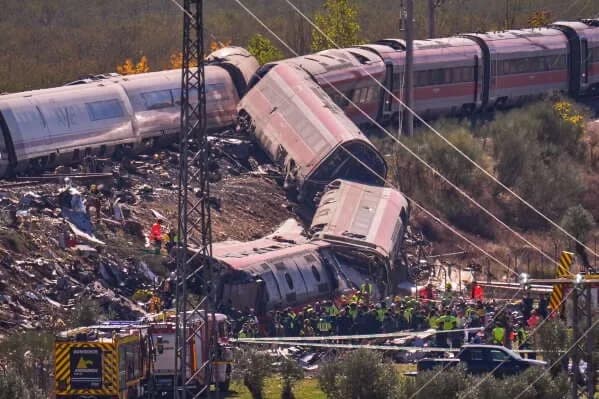

At least 69 people were killed on Wednesday 28 October when a high-speed train ran into the back of another that had stopped on the track south of Madrid, in one of the deadliest rail disasters in Spain's history, the BBC reported. Earlier reports, including the first version of this story, gave a toll of 68.
The collision happened at 8:53 am between the towns of Mora and Orgaz in Toledo province, near Urda, about 140 km south of the capital on the Madrid–Seville high-speed line. A state-operated Renfe train struck a stationary train run by the private operator Iryo. More than 500 passengers were on board the two trains.
More than 100 people were treated for injuries. The next day about 50 were still in hospital, 15 of them in critical condition. Fire crews and helicopters joined a large emergency response, hospitals in Toledo, Ciudad Real and Alcázar de San Juan suspended planned surgery, and a blood transfusion centre in Madrid appealed for urgent donations.
The BBC reported that a computer failure at about 8:30 am had halted six moving trains. Audio recordings showed that a train was given clearance to move at 8:36 even though another ahead of it had stalled, and that controllers told its driver to disconnect and reconnect the LZB train-protection system and resume the journey at normal speed. Why that instruction was given is central to the questions now being asked about the crash.
Prime Minister Pedro Sánchez visited the crash site and said the government would get to the bottom of the tragedy. Spain declared three days of national mourning, politicians cancelled public engagements and suspended election campaigning, and the Civil Guard opened offices in Madrid, Toledo, Seville and Córdoba to take reports of missing people and DNA samples from relatives.
It is the second deadly high-speed rail accident in Spain this year. In January a high-speed train derailed in the south of the country and its rear carriages ran into the path of a Renfe train, killing 46 people.
This report was expanded and updated on 1 November 2026 with details published by the BBC and AP.